
Point to Pinnacle: a nutrition guide
With Point to Pinnacle approaching, I’ve put together this guide to help runners plan their nutrition for the event. The guide outlines how I would fuel a run in personal-best shape—1:56, or just under two hours—and offers suggestions for other goal times.
Why nutrition matters
I’m often surprised by how little attention runners give nutrition compared with training, shoes and gadgets that promise a faster personal best. Those things matter—and they’re fun to geek out on—but fuelling deserves attention too. Shout-out to Geoff and Jay at The Running Edge for supporting my shoe addiction!
Good nutrition can’t make up for a lack of training, but not giving your body the fuel it needs can certainly undo a lot of good work!

Individual needs: an important note
Everyone’s nutritional needs and tolerances differ. This plan works for me, but if you have a medical condition or specific dietary requirements, seek individualised professional advice.
Race day: Sunday 15 November 2026. Wrest Point to the summit of kunanyi / Mount Wellington.
Distance: 21.1km
Elevation: 1271m
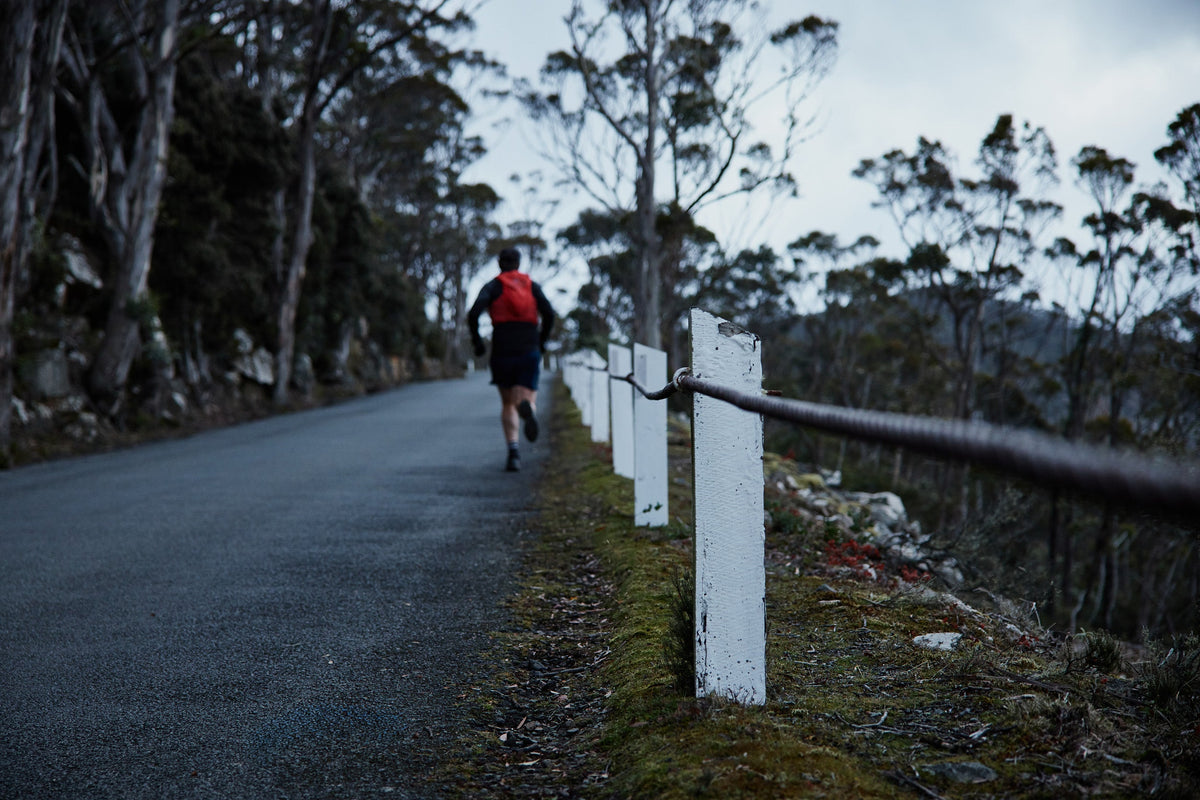
This is no ordinary half marathon—it’s the world’s toughest road half marathon! With 1,271 m of climbing, expect a much longer finish time than on a flat course. For perspective, I ran 1:56 at P2P when I was running around 1:25 at the Cadbury half marathon. The final 5 km feels like the closing stages of a full marathon!
When you are making a pacing and nutrition plan, bear in mind that the second half is steeper than the first half.
My pacing plan for a 2-hour finish
I divided my target time into two segments to account for the steeper climb in the second half:
- First 10 km to Ferntree: 50 minutes at 5:00/km, with about 460 m of climbing. The opening kilometre or two are relatively quick so you can bank a little time here.
- Final 11 km: 70 minutes at roughly 6:20/km, with around 800 m of additional climbing.
Allowing for the steeper second half
My plan allowed for a pace roughly 20–25% slower in the second half as the gradient steepened. That adjustment is personal: hills aren’t my strength, so other runners may slow down less—or more.
The below table is an example of a pacing strategy with the goal of slowing down by 20% as the gradient steepens:
| Finish Time | First 10km Pace (/Km) | Last section pace (/Km) | First 10km Split |
| 2:00:00 | 5:09 | 6:11 | 0:51:28 |
| 2:15:00 | 5:47 | 6:57 | 0:57:54 |
| 2:30:00 | 6:26 | 7:43 | 1:04:20 |
| 2:45:00 | 7:05 | 8:29 | 1:10:46 |
| 3:00:00 | 7:43 | 9:16 | 1:17:12 |
| 3:15:00 | 8:22 | 10:02 | 1:23:38 |
| 3:30:00 | 9:00 | 10:48 | 1:30:04 |
Equipment options
Your equipment determines how much fuel and fluid you can carry. Here are three options:
Pockets only: Carry gels in your pockets and drink water from cups at aid stations.
Handheld bottle or waistband flasks: Carry gels alongside drink mix or electrolytes. You can start with powder in an otherwise empty bottle and add water at an aid station when needed.
Running belt or vest: Carry pre-filled flasks or a hydration bladder, with room for drink mix, gels and even solid food if you expect to take three hours or more.
My preferred setup
I use a Naked waistband to carry my phone and reusable soft flasks filled with gel. I also tuck a small bottle into the waistband because drinking from aid-station cups isn’t my strong point.
I start with just electrolyte mix powder in the bottle, then collect cups of water at an aid station and fill it on the move. That lets me sip between stations—rather than ending up with a wet T-shirt and not enough water drunk.
Product options
Gels
Individual sachets: Most contain around 25–30 g of carbohydrate, depending on the brand and size.
Resealable pouch: Our pouch holds the equivalent of four gels (100 g of carbohydrate). Sip as you go without having to dispose of or carry sticky sachets.
The Ultra: My preferred option. Fill a soft flask with the equivalent of four gels and tuck it into your pocket or waistband.
Drink mixes
Typical serving: Most mixes provide around 40 g of carbohydrate when prepared with 500–600 mL of water. You can dilute them to suit your taste.
Electrolyte content: Many mixes also contain electrolytes, with sodium being the most important. Our drink mix, for example, is relatively high in sodium at 500 mg per serving.
Electrolytes
Options include drink mix sachets, effervescent tablets and salt tablets. Plan what you’ll use, particularly if hot weather is expected.
For more information, see our introductory guide to the Moor Endurance product range here.
How much fuel to take—and when
Choosing a carbohydrate target
- There is no one-size-fits-all answer. Carbohydrate needs and tolerance vary:
- For most runners: Around 40–60 g of carbohydrate per hour is a useful starting target.
- For well-trained athletes: Some can absorb upwards of 90 g per hour, but this requires a combination of glucose and fructose, along with plenty of practice to train the gut.
- My target: I find that about 60 g per hour works well for me.
Planning your gel timing
Use the carbohydrate content of your gels to work out how often to take them. For example, a target of 50 g per hour means taking two gels containing 25 g each—one every 30 minutes.
Taking gels with water
Most gels are best taken with a little water. Thick gels with a high concentration of ingredients can have high osmolarity, which may upset your stomach.
Moor gels have relatively low osmolarity, which may make them easier to tolerate. Timing your gels around water stations can also help reduce the risk of stomach discomfort.
Before the start: a pre-race checklist
- The night before: Choose a familiar, carbohydrate-rich dinner, such as pasta, rice or potatoes. Avoid anything new or heavy. I would eat this way for a few days beforehand as a modest carbohydrate load, much as I would before a marathon.
- 2–3 hours before the start: Have a familiar, easily digested carbohydrate breakfast, such as toast with jam, along with water or electrolytes.
- 10–15 minutes before the start: Take one gel with a few sips of water.
My nutrition plan for a 2-hour goal time:
1x gel on the start line (25g)
1 x Moor soft flask with raspberry (4 gels/100g) – sip as I go. Aim to have half done by the springs. pic of the flask here?
1x sachet of blackcurrant hydration formula (500mg sodium/15g carbs). Mix in my bottle from The Springs and sip.
1 x emergency gel (25g). It’s always with me. Not necessarily for my own emergency, could be for someone else’s!
For more information check out our fueling guide here.
Final Tips:
Practice before race day!
With the race only a few weeks away, you have time for two or three dress rehearsals. Use your longest climbing run to test the exact plan you will race with.
- Use the same flavours, the same timing and the same bottle you will race with.
- Practice taking gels while moving uphill and while power-walking, because that is how you will actually be eating on the day.
- If your stomach struggles at 50 to 60 g per hour, drop back and build up over several sessions. Your gut can be trained.
Race day checklist:
- Gels and drink mix sachets counted out according to your plan, plus one spare gel
- Pre-race gel in your pocket or vest
- Bottle or bladder if you are choosing to carry some with you
- Watch alarm set for your fueling times
- Warm layers for the summit
Good luck to everyone in their training and on race day and don’t forget to think about your nutrition!
Rob

Share:
World Record Attempt Fuelled by Moor